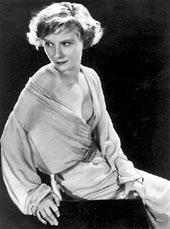
The death of aspiring starlet Peg Entwistle has come to be regarded as Hollywood folklore at its finest. Much of it is composed of fact, but much also of hearsay and urban legend, nourished by a sentiment to which almost anyone who has ever struggled with their art can relate.
Following the death of her mother, Entwistle migrated to the United States with her father and brothers in the 1920s after growing up in Wales and London. When her father was run over by a truck on New York’s Park Avenue, her brothers headed west, seeking their fortunes like so many others in California. Peg remained in New York, bitten by the stage bug and starting to get roles in the theatre. She enjoyed some success, acting opposite rising stars such as Humphrey Bogart.
She was only 19 when she married an older actor, Robert Keith, but after the marriage fell apart she decided to follow her brothers’ example and in 1932 travelled west to join them in Los Angeles.
There the blue-eyed platinum blonde had almost immediate success, scoring a movie role in Thirteen Women, a melodrama starring Myrna Loy and Irene Dunne about a group of former school-friends getting horoscopes from a fortune-teller who is working under an evil influence. Unfortunately for Entwistle, most of her part ended up on the cutting room floor. She found herself out of work, friendless and depressed, without even enough money to take the train back east to New York and put Hollywood behind her. Instead, she used Hollywood itself to take her own life.
Hollywood began as a developer’s subdivision in 1923 called Hollywoodland, in Beachwood Canyon above the plain of Los Angeles. The “Hollywoodland” sign was lit up by thousands of light bulbs, but when the development failed, all that remained of the scheme was the sign, up on the craggy slopes of Mount Lee. It fell into disrepair, and the final syllable “land” was removed, rendering the word the familiar “Hollywood”. The entertainment business came to recognise its importance, and in 1978 it was restored through a subscription campaign in which companies and individuals paid for a letter. Among those said to have taken part were Playboy millionaire Hugh Hefner, who paid for the Y, and rock star Alice Cooper, who paid for one of the O’s, in memory of Groucho Marx.
On 16 September 1932, having told her family she was meeting friends at the local drugstore, Peg Entwistle put on a borrowed dress, wrote her suicide note, and began scrabbling up through the brush and stony slopes of Mount Lee. There she left the note along with her purse and coat, and used a workmen’s ladder to climb the 50 feet to the top of the H letter. She jumped head first, tumbling down the rocks and ravines below.
Her body was sighted the following day by a woman hiking in Griffith Park, who reported the matter to the police. Her body was recovered and a post-mortem done, which concluded that she died of multiple fractures to the pelvis, and may have survived the fall for some time with agonising internal injuries. Her body was cremated, and later interred in Cincinnati, Ohio beside the remains of her father.
Tragically, a letter which had been posted on the day before her death arrived the day after she was found, offering her a part in a forthcoming stage production at the Beverly Hills Playhouse. She was to have played the part of a young woman who commits suicide in the final act.
In the decades since her death there have been numerous reports of hikers spotting a sad-looking blonde in a 1930s era dress, some of them saying she literally shimmered and vanished before their eyes. Others have reported the strong smell of gardenia while walking in the area: it was Peg Entwistle’s favourite scent. In recent decades special hi-tech sensors have been placed at the sign to help deter would-be copycat suicides.
The film Thirteen Women opened to generally poor reviews, although Peg Entwistle received good notices for what was left of her part. The suicide note she left read: “I am afraid I am a coward. I am sorry for everything. If I had done this a long time ago, it would have saved a lot of pain.”
From my book Dead Famous: Deaths of the Famous and Famous Deaths.
“I’m afraid I’m being an awful nuisance.”
- last words of poet Edith Sitwell, died 1964